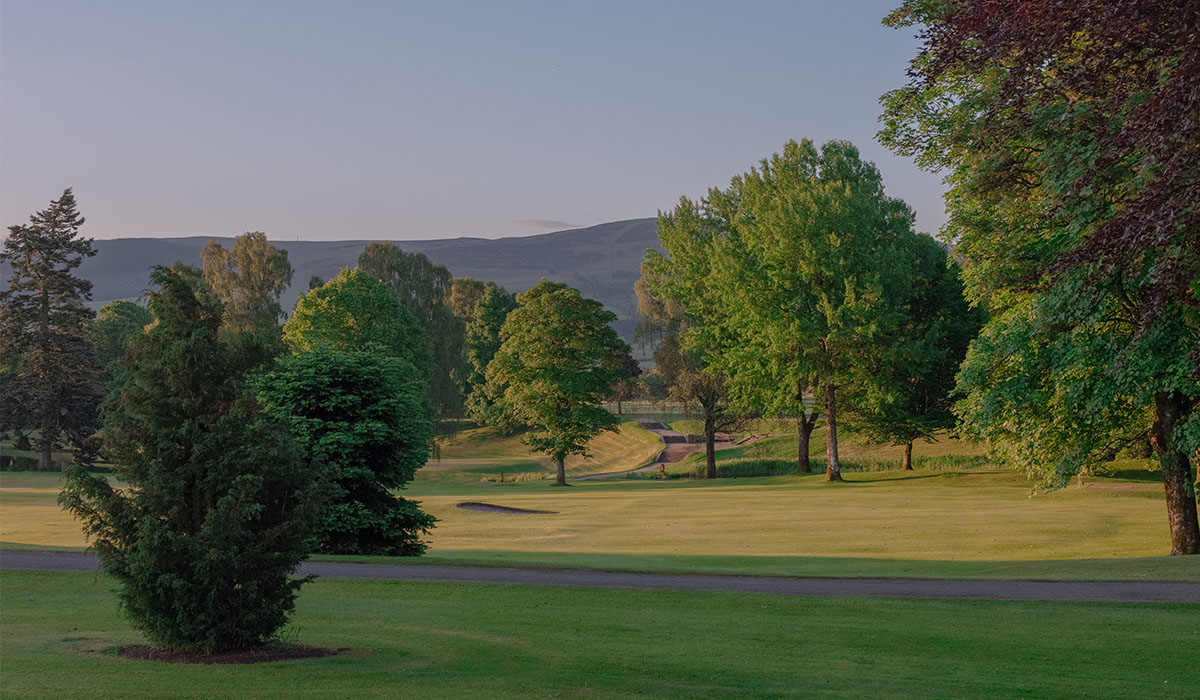
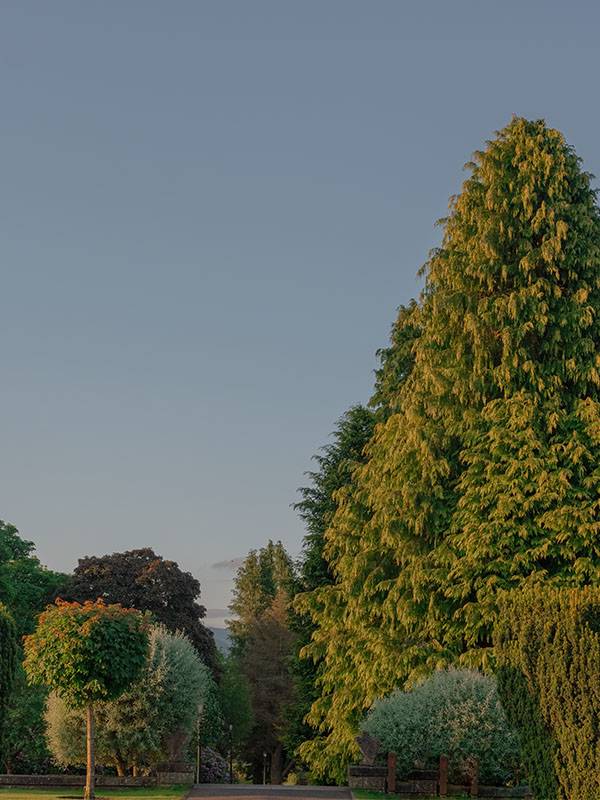
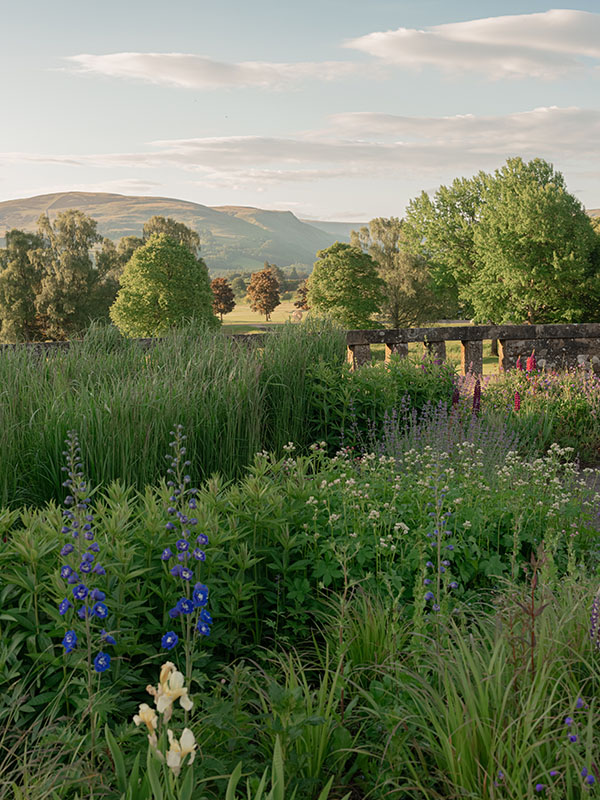
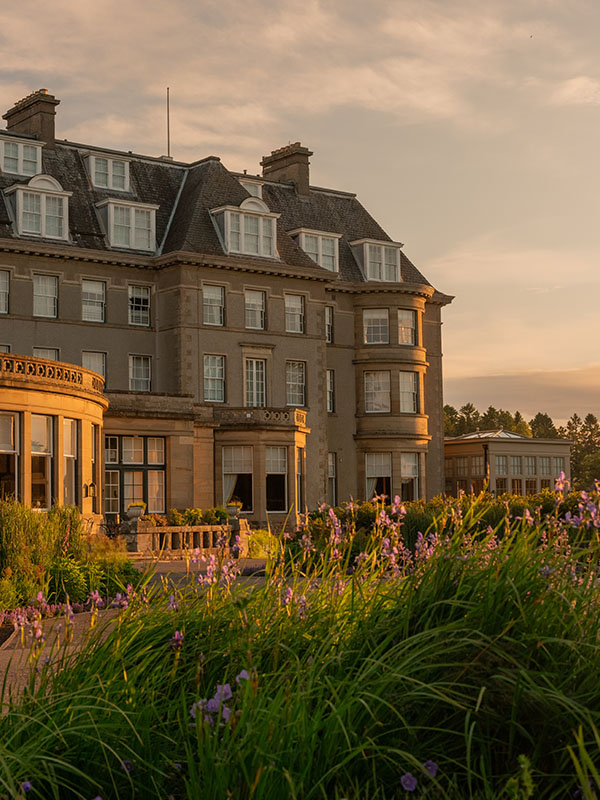
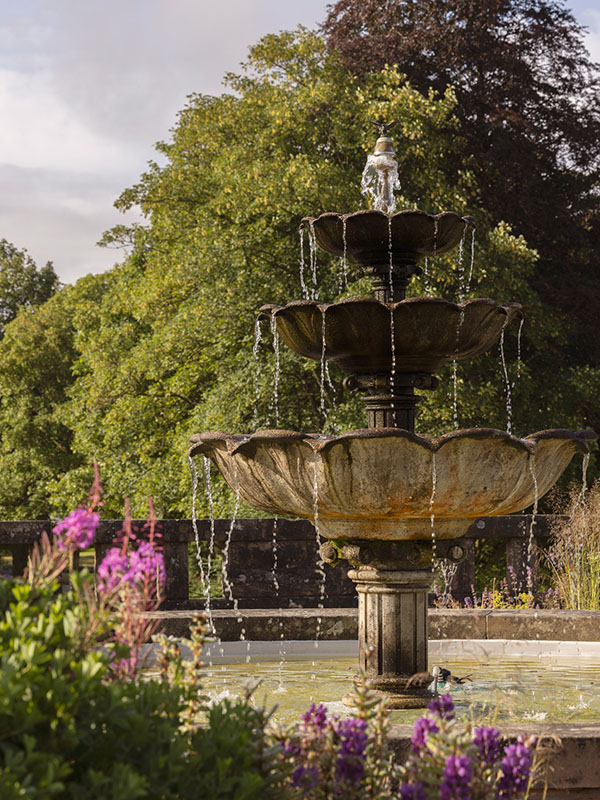
Gleneagles absorbed these trends but translated them at scale. Where a country house might boast a sequence of garden rooms, here those rooms were amplified to generously accommodate promenading guests, tennis players strolling to the courts in their whites or those taking afternoon tea on the front terrace. The hotel’s axial approaches and generous lawns echoed Edwardian confidence, yet beyond the immediate architecture, the landscape relaxed into the wider Perthshire panorama: rolling greens, distant hills and mature woodlands.
Some of the trees scattered across the grounds predate the hotel itself, with many having celebrated their centenary year long before we did in 2024. Historically, Gleneagles relied heavily on structural planting such as trees and shrubs to shape its timeless design. Aside from the trees, rhododendrons formed a backbone to the landscape, evidence of which you can still see throughout the grounds. As well as being visually pleasing, they’re also important because they create microclimates, offering shelter for smaller animals.
Post-war, in the late twentieth century, Britain rediscovered romance in looser planting schemes and had a renewed interest in ecological sensitivity. Across Scotland, the rigid lawns and borders gave way to naturalistic drifts. And while in some ways Gleneagles’ design reflected the broader trends of the times, the gardens equally retained much of their original boundaries and borders, offering guests across the ages a sense of continuity.
Today, that continuity is guided by Gardens & Estate Manager William Moir, whose understanding of horticulture and land management shapes the work of his fourteen-strong team. A local to the area, Moir grew up nearby and remembers the hotel as something almost mythical. “I grew up in a small village down the road, and Gleneagles was the sort of place we only dreamed of going,” he recalls. “It always had a magical aura.”
His team cares for all of the grounds, excluding the golf courses, with their work ranging from landscaping and path-laying to vegetable cultivation and ornamental planting. Their day begins early, often from 6am, ensuring the gardens appear effortless by the time guests emerge from breakfast. “It doesn’t matter if we’re blowing leaves, cutting grass or laying a path,” he says. “Whatever we do, we do it to the highest standard and with the least disruption to our guests. I take real pride in everything looking good.”
Moir speaks of the gardens not as static compositions but as living systems. “You’re always working with time,” he reflects. “Some of what we plant now will define the view long after we’re gone.”
His own approach builds on this legacy while introducing a more contemporary sensibility. “I’d describe our current style as contemporary prairie planting, but with a distinctly Scottish feel,” he says. “We utilise a modern interpretation of traditional planting — it tries to tick all the boxes.”
This balance is central to every decision. “Our planting is always a careful balance between beauty, what looks natural in the setting, and what will genuinely thrive here,” he explains. “The planting we do isn’t typical of high-end hotels. It’s quite unique because of where we are and the combinations we’ve chosen.”
The environment now plays a defining role in shaping those decisions. “Because of our changing climate, we have to use plants that are more drought-tolerant,” he says. “We’re seeing longer, hotter periods in summer and more sustained rain in winter. We have to balance good drainage with plants that can withstand weeks without rain in July or August.”
Ecology is equally central. “We always try to strike a balance between what’s ornamental and what’s functional for the environment,” he says. “For example, we prioritise single flowers rather than doubles. Single petals drain better in the rain and are much more accessible for pollinators. We replanted along The Golden Path this year and from early summer right through to late autumn it was buzzing with bees and butterflies.”
Seasonality remains fundamental to the guest experience. “We’re busy all year round, so we have to make sure there’s always something interesting to look at,” he says. “We stagger our planting so there’s colour and texture across all twelve months.” Scotland’s climate lends its own intensity. “Our growing season is slightly more condensed than further south, but the long summer days create an incredible abundance all at once.”
Colour palettes are carefully considered, reinforcing the connection between interior and exterior spaces. “The colours we use reflect the interiors of the hotel — shades of purples, greens and golds,” he explains. “It creates a sense of continuity between the building and the landscape.”
Recent projects demonstrate this philosophy in practice. “As I mentioned, last year we focused on enhancing the borders along The Golden Path, and it was such a success that we’re now extending that approach to the Ochil House side of the hotel,” he says. “We’re going to be introducing more colour and texture, but without simply copying what’s already there. Each space needs its own identity.”
The shift also reflects broader changes in gardening itself. Not long ago, Gleneagles produced tens of thousands of bedding plants on site each year — bright, short-lived displays that required constant replacement. “That’s not something we’d do now,” Moir says. “We’re much more conscious of minimising waste and creating planting schemes that endure.”
He sees this transition as part of a longer historical continuum. As the historian Jenny Uglow observes in Little History of British Gardening, elaborate bedding displays were once a symbol of social status — their sheer scale a demonstration of wealth and control. Today, that emphasis has shifted towards sustainability, longevity and ecological integration.